---
title: "Scaling Pharmacist-Delivered Clinical Services: Webinar Recap & Key Takeaways"
description: Explore key insights from our webinar on scaling pharmacist-delivered clinical services, addressing barriers & opportunities for better healthcare access.
image: https://blog.pocp.com/hubfs/undefined-1.jpeg
---
[](https://www.pocp.com/)
# Accelerating client's success
# using Health IT and
# business process solutions...
[Learn More](https://www.pocp.com/the-pocp-story/)
# Simplifying
# regulatory
## compliance...
[Learn More](https://www.pocp.com/regulatory-resource-center/)
# Creating value in today's
# healthcare ecosystem...
[Learn More](https://www.pocp.com/our-client/)
- Consulting
- [Strategy & Market Intelligence](https://www.pocp.com/strategy-market-intelligence/)
- [Education & Research](https://www.pocp.com/education-research/)
- [Value-Based Care Interoperability Roadmap](https://info.pocp.com/en-us/value-based-care-interoperability-strategy-and-roadmap)
- [Multi-stakeholder Collaboratives, Program Design and Management](https://www.pocp.com/multi-stakeholder-initiatives_program-design_management)
- [EHR Training Programs](https://www.pocp.com/ehr-training-programs/)
- [Life Sciences](https://www.pocp.com/life-sciences)
- [Regulatory Resource Center](https://www.pocp.com/regulatory-resource-center)
- About Us
- [The POCP Story](https://www.pocp.com/the-pocp-story/)
- [Our Clients](https://www.pocp.com/our-client/)
- [Health & IT Vendors](https://www.pocp.com/our-client/health-it-vendors/)
- [Payers & PBMS](https://www.pocp.com/our-client/payers-pbms/)
- [Accountable Care](https://www.pocp.com/our-client/accountable-care/)
- [Health Information Exchange](https://www.pocp.com/resource-library/health-information-exchange/)
- [Our Team](https://www.pocp.com/our-team/)
- [Government Contracting](https://info.pocp.com/gsa)
- [Press](https://www.pocp.com/press/)
- [Calendar](https://info.pocp.com/en-us/events)
- [Careers at POCP](https://www.pocp.com/the-pocp-story/careers-at-pocp/)
- Insights
- [Articles and Industry Comments](https://www.pocp.com/articles/)
- [Blog](https://blog.pocp.com/blog/)
- [Newsletters HIT Perspectives](https://www.pocp.com/insight/newsletters-2/)
- [Newsletters Biopharma](https://www.pocp.com/newsletters-biopharma/)
- [POCP Industry Reports](https://www.pocp.com/industry-reports)
- [POCP Industry Reports](https://www.pocp.com/industry-reports)
- [ePrior Authorization’s Real Benefits: Reducing Frictional Costs and Speeding Time to Therapy](https://www.pocp.com/downloads/ePAReport)
- [Real-Time Pharmacy Benefit Check Report](https://www.pocp.com/pocp-industry-reports/real-time-pharmacy-benefit-check-report/)
- [Fighting the Opioid Epidemic at the State- and Rx-Level Report](https://www.pocp.com/downloads/fighting-opioid-epidemic-at-rx-level-report)
- [ePrescribing State Law On-Demand](https://www.pocp.com/downloads/eprescribing-state-law-on-demand/)
- [State Law Review](https://www.pocp.com/statelawreview/)
- [Navigator](https://www.pocp.com/navigator/)
- [Podcasts](https://info.pocp.com/en-us/the-dish-on-health-it-podcast)
- [Presentations and Webinars](https://www.pocp.com/presentations/)
- [Resource Library](https://www.pocp.com/resource-library/)
- [White Papers, Webinars and Case Studies](https://www.pocp.com/white-papers-webinars-and-case-studies-2/)
- [Our video channel](https://www.pocp.com/our-video-channel)
- [Contact](https://www.pocp.com/contact/)
- Consulting
- [Strategy & Market Intelligence](https://www.pocp.com/strategy-market-intelligence/)
- [Education & Research](https://www.pocp.com/education-research/)
- [Value-Based Care Interoperability Roadmap](https://info.pocp.com/en-us/value-based-care-interoperability-strategy-and-roadmap)
- [Multi-stakeholder Collaboratives, Program Design and Management](https://www.pocp.com/multi-stakeholder-initiatives_program-design_management)
- [EHR Training Programs](https://www.pocp.com/ehr-training-programs/)
- [Life Sciences](https://www.pocp.com/life-sciences)
- [Regulatory Resource Center](https://www.pocp.com/regulatory-resource-center)
- About Us
- [The POCP Story](https://www.pocp.com/the-pocp-story/)
- [Our Clients](https://www.pocp.com/our-client/)
- [Health & IT Vendors](https://www.pocp.com/our-client/health-it-vendors/)
- [Payers & PBMS](https://www.pocp.com/our-client/payers-pbms/)
- [Accountable Care](https://www.pocp.com/our-client/accountable-care/)
- [Health Information Exchange](https://www.pocp.com/resource-library/health-information-exchange/)
- [Our Team](https://www.pocp.com/our-team/)
- [Government Contracting](https://info.pocp.com/gsa)
- [Press](https://www.pocp.com/press/)
- [Calendar](https://info.pocp.com/en-us/events)
- [Careers at POCP](https://www.pocp.com/the-pocp-story/careers-at-pocp/)
- Insights
- [Articles and Industry Comments](https://www.pocp.com/articles/)
- [Blog](https://blog.pocp.com/blog/)
- [Newsletters HIT Perspectives](https://www.pocp.com/insight/newsletters-2/)
- [Newsletters Biopharma](https://www.pocp.com/newsletters-biopharma/)
- [POCP Industry Reports](https://www.pocp.com/industry-reports)
- [POCP Industry Reports](https://www.pocp.com/industry-reports)
- [ePrior Authorization’s Real Benefits: Reducing Frictional Costs and Speeding Time to Therapy](https://www.pocp.com/downloads/ePAReport)
- [Real-Time Pharmacy Benefit Check Report](https://www.pocp.com/pocp-industry-reports/real-time-pharmacy-benefit-check-report/)
- [Fighting the Opioid Epidemic at the State- and Rx-Level Report](https://www.pocp.com/downloads/fighting-opioid-epidemic-at-rx-level-report)
- [ePrescribing State Law On-Demand](https://www.pocp.com/downloads/eprescribing-state-law-on-demand/)
- [State Law Review](https://www.pocp.com/statelawreview/)
- [Navigator](https://www.pocp.com/navigator/)
- [Podcasts](https://info.pocp.com/en-us/the-dish-on-health-it-podcast)
- [Presentations and Webinars](https://www.pocp.com/presentations/)
- [Resource Library](https://www.pocp.com/resource-library/)
- [White Papers, Webinars and Case Studies](https://www.pocp.com/white-papers-webinars-and-case-studies-2/)
- [Our video channel](https://www.pocp.com/our-video-channel)
- [Contact](https://www.pocp.com/contact/)
# Insights: Brief Points of View
# POCP Blog
---
## Scaling Pharmacist-Delivered Clinical Services: Webinar Recap & Key Takeaways
- September 03, 2026
- By [Tony Schueth](https://blog.pocp.com/blog/author/tony-schueth)
- [0 Comment](https://blog.pocp.com/blog/scaling-pharmacist-delivered-clinical-services-webinar-recap-key-takeaways#comments-listing)
Share this story:
For decades, healthcare leaders have discussed enabling pharmacists to practice at the top of their training. Successful programs, promising pilots, and growing evidence show that pharmacist-delivered clinical services can improve outcomes and provide cost-effective care, yet these services have not consistently scaled.
That was the focus of our recent webinar, **Scaling Pharmacist-Delivered Clinical Services Across a Fragmented State Policy Landscape**, which I presented alongside Seth Joseph, Managing Director of Summit Health Advisors, and Keith Fisher, MS, RPh, POCP Senior Consultant and Regulatory Resource Center Co-Editor.
This topic matters to me because community pharmacists are a highly trained, trusted and underused healthcare resource, particularly in communities with limited access to other healthcare professionals.
At a time of persistent care gaps, rising costs and provider shortages, how can we make better use of the healthcare professionals already in our communities?
#### *Watch the full webinar below or continue reading for several of the most important takeaways.*
## Two Whitepapers Helped Frame the Discussion
Our webinar drew on two complementary NCPDP Foundation grant-funded research efforts: one examining the infrastructure pharmacists need to deliver clinical services and another addressing the business model required to scale these services.
The first, [*Pharmacy Interoperability: A Comprehensive Assessment of the Current Landscape*](https://blog.pocp.com/hubfs/White%20Papers%20and%20Reports/Pharmacy%20Interoperability%20Whitepaper_NCPDP%20Foundation%20Grant.pdf?hsLang=en), explored what it will take to get the right clinical information into pharmacy systems and pharmacists’ workflows so they can provide services beyond medication dispensing.
As I reviewed that research, one question kept coming back to me: Even if we build the technology and data-exchange infrastructure, what will create enough demand and financial incentives for organizations to invest in and use it?
That question led to the second whitepaper, [*A Business Model Framework to Scale Pharmacy-Delivered Clinical Services*](https://43141858.fs1.hubspotusercontent-na1.net/hubfs/43141858/NCPDP/A%20Business%20Model%20Framework%20to%20Scale%20Pharmacy-Delivered%20Clinical%20Services.pdf)*.* Developed with Summit Health Advisors, we conducted more than 30 interviews with senior leaders from health plans, PBMs, pharmacy organizations, technology companies, and government. The research examined what is preventing pharmacist-delivered services from becoming a more sustainable and integrated part of healthcare delivery.
The conclusion was clear: The question is no longer whether pharmacists can deliver valuable clinical care. The harder problem is creating a business model that allows those services to scale and be sustainable.
## The Opportunity Is Already in Our Communities
Community pharmacists sit at the intersection of medication access, patient engagement and clinical information. Patients see them more frequently than many other healthcare professionals, and pharmacies are often easier to access than traditional care settings.
Pharmacists are already delivering valuable services, including:
For Medicare Advantage plans, pharmacist-delivered care may support adherence, quality performance and Star Ratings. Medicaid plans may value better access in communities with provider shortages, while commercial plans may prioritize convenience and lower-cost care settings.
The value proposition will differ by population and market, but the underlying opportunity is consistent. Pharmacists can help address needs that the rest of the healthcare system is struggling to meet.
## Why Hasn’t Pharmacist-Delivered Care Scaled?
Our research identified several interconnected barriers:
Many successful programs remain isolated. One health plan may reimburse pharmacists for a particular service in a market while other plans do not. That leaves pharmacies managing different requirements, payment models and workflows for relatively small patient populations.
Pharmacies need enough concentrated demand to justify investments in staffing, scheduling, billing, technology and training. Without it, successful programs remain isolated, forcing pharmacies to manage different requirements, payment models and workflows for small patient populations.
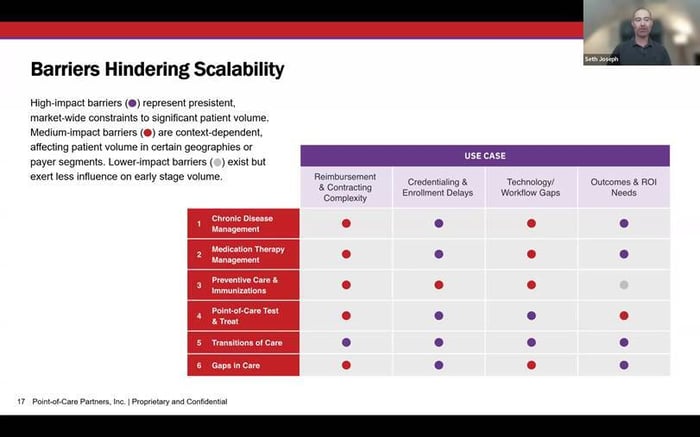
*Webinar slide: The barriers vary by use case, but many of the most significant constraints are structural and repeat across services.*
The whitepaper illustrates this challenge through an S-curve model. At low volumes, programs may remain financially insignificant and dependent on grants or pilots. As volume grows, workflows become more predictable, staff competency and outcomes data improve, and the economics strengthen.
At sufficient scale, clinical services can become part of the pharmacy’s core business rather than something operating at its margins.
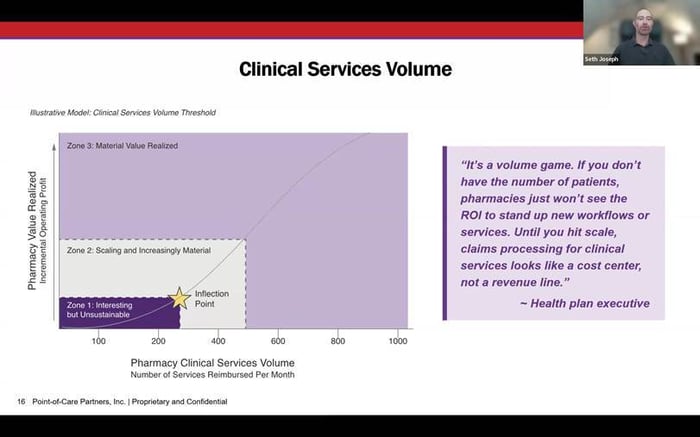
*Webinar slide: The illustrative clinical services volume model shows the inflection point between an interesting but unsustainable program and one that begins to generate material value.*
That changes the question. Instead of asking how we persuade more pharmacists to offer clinical services, we should ask how health plans and pharmacies can work together to generate enough consistent demand to make those services operationally and financially sustainable.
## PHARMS Offers a Regional Path to Scale
PHARMS, Pharmacy Health Alliances for Reimbursable Medical Services, is one potential framework.
PHARMS would bring health plans and pharmacies together as the principal participants in regional, action-oriented alliances. Technology organizations, PBMs, state pharmacy associations, and other stakeholders could provide important support, but health plans and pharmacies are the parties that need to reach a shared understanding of the services, populations, and business model.
The goal is not to create another national consortium or another open-ended pilot. It is to align the organizations within a market around several practical requirements:
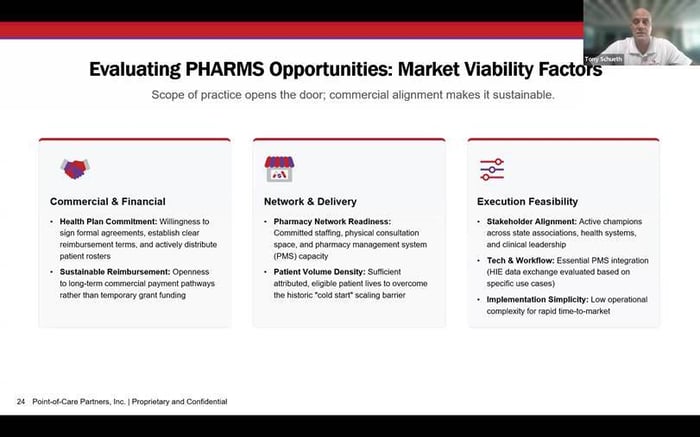
*Webinar slide: Market viability depends on commercial and financial commitment, network and delivery readiness, and execution feasibility.*
I have seen many examples of regional collaboration in other areas of healthcare technology, such as ePrescribing, ePrior Authorization, and health information exchange, just to name a few. We can begin locally, expand statewide, and eventually create the conditions for broader adoption. The key is to bring the right organizations together around a specific opportunity and move from discussion to execution. And the goal isn’t a successful project; it’s long-term, sustainable improvements in our healthcare system.
## Health Plans Have an Important Role to Play
Health plans are particularly well positioned to help create the concentrated demand these models require. They understand their populations bear financial risk in many lines of business and are accustomed to developing clinical networks and measuring performance.
Implementation models can vary: some plans may contract with and reimburse pharmacies directly, while others may use PBMs or other organizations to administer portions of the program.
What matters is that health plans and pharmacies agree on the population, services, workflows, reimbursement and measures of success.
We recently explored the health plan perspective further on [**The Dish on Health IT**.](https://info.pocp.com/pharmacy-clinical-services_centene_podcast-ep_aug-2026) Angel Ballew, Head of Pharmacy Clinical Programs & Services at Centene, shared how health plans can engage pharmacists to close care gaps, support chronic condition management and improve patient outcomes.
Her experience reinforces an important point from our research: If health plans are not meaningfully considering pharmacists as part of their clinical and quality strategies, they may be leaving significant value on the table.
*Listen to our latest podcast episode: *
## State Policy Can Determine Where and How a Program Works
A sound business model is essential, but it must still operate within each state’s regulatory environment.
During the webinar, Keith demonstrated how significantly pharmacists’ authority and program requirements can vary. Washington, Virginia and Kentucky provide three useful examples.
Washington relies heavily on collaborative practice agreements. Virginia uses more specifically defined standing orders and protocols. Kentucky represents a hybrid of those approaches.
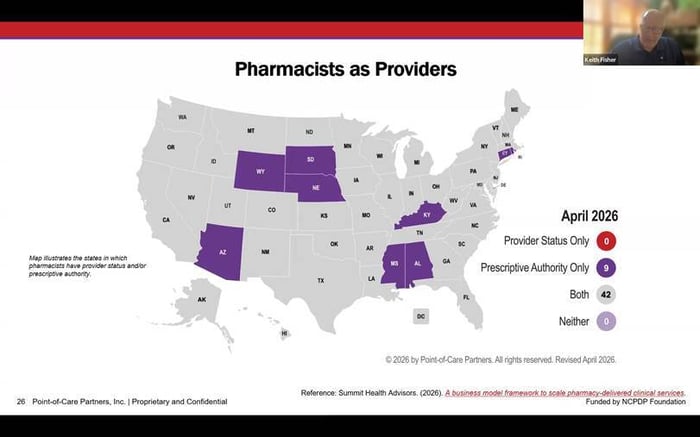
*Webinar slide: POCP’s April 2026 snapshot illustrates how pharmacist provider status and prescriptive authority differ across states.*
For organizations developing multi-state programs, knowing that pharmacists have “provider status” is not enough. They must understand:
These rules also change. Bills may be amended to add relevant authority or fail when a legislature adjourns, making continuous monitoring, verification and interpretation essential.
POCP’s **Regulatory Resource Center** [Advanced Pharmacy Practice Subscription Service](https://info.pocp.com/rrc-pharmacist-advanced-practice) tracks these laws and regulations, collects the underlying source material and organizes the findings into practical state-level summaries. The information is reviewed and updated quarterly so that subscribers can understand both what is permitted and the guardrails that govern it.
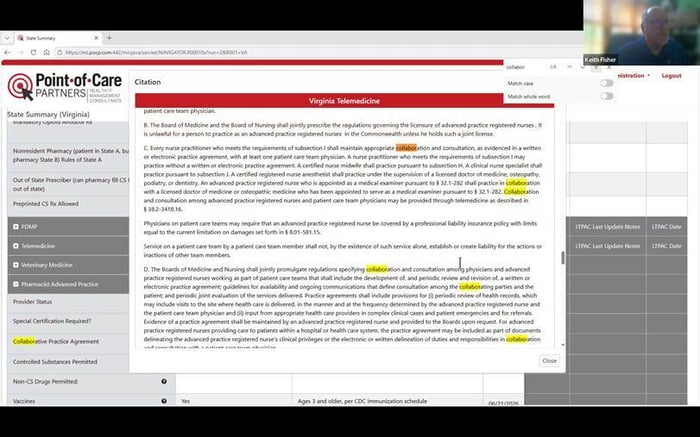
*Webinar demonstration: The Regulatory Resource Center gives subscribers access to state-level summaries and the underlying laws and regulations that inform advanced pharmacy practice requirements.*
For organizations operating across multiple states, this intelligence can support delivering accurate prompts within software used by users who need to comply with their state's regulatory requirements. This intel can also answer an important question before significant resources are committed to standing up PHARMS: Where are the regulatory and market conditions right to move forward?
## The Path to Scale Is Within Reach
I came away from the webinar optimistic because the level of engagement and passion attendees expressed was heartening.
We know pharmacists can improve outcomes and deliver cost-effective care, and more states are expanding pathways for these trusted professionals to serve communities that need better access through accurate prompts. Technology and interoperability are also advancing.
What we still need is the connective tissue: sustainable reimbursement, sufficient patient volume, workable technology and workflows, meaningful performance measures, and alignment among health plans, pharmacies, and other market participants.
This opportunity is too important to leave trapped in an endless cycle of promising pilots. We can build models that improve access, help close care gaps, and make better use of the healthcare resources already available in our communities.
[Contact Point-of-Care Partners](https://www.pocp.com/contact/) for help exploring or implementing PHARMS, or to learn more about the subscription services available through our Regulatory Resource Center.
## Explore the Regulatory Resource Center
Want to see how POCP can help you stay ahead of the state and federal regulatory changes affecting advanced pharmacy practice and other critical areas of healthcare?
Explore our [POCP Regulatory Resource Center](https://www.pocp.com/our-regulatory-resource-center/) subscription services to discover the intelligence, analysis, and state-level tracking available to subscribers.
- Post Categories
- [Population Health Management](https://blog.pocp.com/blog/tag/population-health-management)
- [Medication Adherence](https://blog.pocp.com/blog/tag/medication-adherence)
- [pharmacist](https://blog.pocp.com/blog/tag/pharmacist)
- [pharmacy interoperability](https://blog.pocp.com/blog/tag/pharmacy-interoperability)
- [Pharmacy](https://blog.pocp.com/blog/tag/pharmacy)
- [pharmacy advance practice](https://blog.pocp.com/blog/tag/pharmacy-advance-practice)
- [pharmacy business model](https://blog.pocp.com/blog/tag/pharmacy-business-model)
- [Quality Reporting](https://blog.pocp.com/blog/tag/quality-reporting)
- [Policy monitoring](https://blog.pocp.com/blog/tag/policy-monitoring)
- [care gaps](https://blog.pocp.com/blog/tag/care-gaps)
- [community pharmacy](https://blog.pocp.com/blog/tag/community-pharmacy)
- [State policy](https://blog.pocp.com/blog/tag/state-policy)
- [care access](https://blog.pocp.com/blog/tag/care-access)
- [pharmacy-delivered clinical services](https://blog.pocp.com/blog/tag/pharmacy-delivered-clinical-services)
- [scope of practice](https://blog.pocp.com/blog/tag/scope-of-practice)
# POCP Blog
---
Search
- There are no suggestions because the search field is empty.
### RECENT POSTS
### CATEGORIES
- [Interoperability (40)](https://blog.pocp.com/blog/tag/interoperability)
- [Health IT Policy (39)](https://blog.pocp.com/blog/tag/health-it-policy)
- [CMS (29)](https://blog.pocp.com/blog/tag/cms)
- [FHIR (25)](https://blog.pocp.com/blog/tag/fhir)
- [EHR (24)](https://blog.pocp.com/blog/tag/ehr)
- [Health IT Trends (20)](https://blog.pocp.com/blog/tag/health-it-trends)
- [ePrescribing (19)](https://blog.pocp.com/blog/tag/eprescribing)
- [Prior Authorization (17)](https://blog.pocp.com/blog/tag/prior-authorization)
- [Real-Time Benefit Check (15)](https://blog.pocp.com/blog/tag/real-time-benefit-check)
- [Real-Time Pharmacy Benefit Check (15)](https://blog.pocp.com/blog/tag/real-time-pharmacy-benefit-check)
- [Regulatory Trends (15)](https://blog.pocp.com/blog/tag/regulatory-trends)
- [APIs (14)](https://blog.pocp.com/blog/tag/apis)
- [Artificial Intelligence (13)](https://blog.pocp.com/blog/tag/artificial-intelligence)
- [Life Sciences (12)](https://blog.pocp.com/blog/tag/life-sciences)
- [electronic prior authorization (12)](https://blog.pocp.com/blog/tag/electronic-prior-authorization)
- [health IT (12)](https://blog.pocp.com/blog/tag/health-it)
- [NCPDP (10)](https://blog.pocp.com/blog/tag/ncpdp)
- [Policy (10)](https://blog.pocp.com/blog/tag/policy)
- [pharmacy interoperability (10)](https://blog.pocp.com/blog/tag/pharmacy-interoperability)
- [electronic health records (9)](https://blog.pocp.com/blog/tag/electronic-health-records)
- [ASTP (8)](https://blog.pocp.com/blog/tag/astp)
- [CMS NPRM (8)](https://blog.pocp.com/blog/tag/cms-nprm)
- [Payer (8)](https://blog.pocp.com/blog/tag/payer)
- [health information exchange (8)](https://blog.pocp.com/blog/tag/health-information-exchange)
- [HL7 (7)](https://blog.pocp.com/blog/tag/hl7)
- [Specialty Pharmacy (7)](https://blog.pocp.com/blog/tag/specialty-pharmacy)
- [Standards Development (7)](https://blog.pocp.com/blog/tag/standards-development)
- [TEFCA (7)](https://blog.pocp.com/blog/tag/tefca)
- [Value-Based Care (7)](https://blog.pocp.com/blog/tag/value-based-care)
- [e-Prescribing (7)](https://blog.pocp.com/blog/tag/e-prescribing)
- [electronic prescribing (7)](https://blog.pocp.com/blog/tag/electronic-prescribing)
- [Da Vinci Project (6)](https://blog.pocp.com/blog/tag/da-vinci-project)
- [Federal Healthcare Policy (6)](https://blog.pocp.com/blog/tag/federal-healthcare-policy)
- [HHS (6)](https://blog.pocp.com/blog/tag/hhs)
- [HTI-2 (6)](https://blog.pocp.com/blog/tag/hti-2)
- [ONC (6)](https://blog.pocp.com/blog/tag/onc)
- [Payer Interoperability (6)](https://blog.pocp.com/blog/tag/payer-interoperability)
- [Pharmacy (6)](https://blog.pocp.com/blog/tag/pharmacy)
- [Strategy and Research (6)](https://blog.pocp.com/blog/tag/strategy-and-research)
- [healthcare reform (6)](https://blog.pocp.com/blog/tag/healthcare-reform)
- [pharmaceutical marketing (6)](https://blog.pocp.com/blog/tag/pharmaceutical-marketing)
- [21st Century Cures Act (5)](https://blog.pocp.com/blog/tag/21st-century-cures-act)
- [Consent (5)](https://blog.pocp.com/blog/tag/consent)
- [EHR Usability (5)](https://blog.pocp.com/blog/tag/ehr-usability)
- [EPCS (5)](https://blog.pocp.com/blog/tag/epcs)
- [Health Plans (5)](https://blog.pocp.com/blog/tag/health-plans)
- [Health Technology Solutions (5)](https://blog.pocp.com/blog/tag/health-technology-solutions)
- [Information Blocking (5)](https://blog.pocp.com/blog/tag/information-blocking)
- [NCPDP SCRIPT (5)](https://blog.pocp.com/blog/tag/ncpdp-script)
- [Patient Data (5)](https://blog.pocp.com/blog/tag/patient-data)
- [Strategic roadmap (5)](https://blog.pocp.com/blog/tag/strategic-roadmap)
- [health equity (5)](https://blog.pocp.com/blog/tag/health-equity)
- [pharmacy advance practice (5)](https://blog.pocp.com/blog/tag/pharmacy-advance-practice)
- [population health (5)](https://blog.pocp.com/blog/tag/population-health)
- [Clinical Decision Support (4)](https://blog.pocp.com/blog/tag/cds)
- [Digital Health Programs (4)](https://blog.pocp.com/blog/tag/digital-health-programs)
- [Digital Therapeutics (4)](https://blog.pocp.com/blog/tag/digital-therapeutics)
- [EHR Dashboard (4)](https://blog.pocp.com/blog/tag/ehr-dashboard)
- [HIE (4)](https://blog.pocp.com/blog/tag/hie)
- [Healthcare AI (4)](https://blog.pocp.com/blog/tag/healthcare-ai)
- [Meaningful Use (4)](https://blog.pocp.com/blog/tag/meaningful-use)
- [PDMP (4)](https://blog.pocp.com/blog/tag/pdmp)
- [Pharmaceutical Manufacturers (4)](https://blog.pocp.com/blog/tag/pharmaceutical-manufacturers)
- [Pharmacy Benefit Management (4)](https://blog.pocp.com/blog/tag/pharmacy-benefit-management)
- [burden reduction (4)](https://blog.pocp.com/blog/tag/burden-reduction)
- [ePrior Authorization (4)](https://blog.pocp.com/blog/tag/eprior-authorization)
- [healthcare regulations (4)](https://blog.pocp.com/blog/tag/healthcare-regulations)
- [price transparency (4)](https://blog.pocp.com/blog/tag/price-transparency)
- [Administrative Burden (3)](https://blog.pocp.com/blog/tag/administrative-burden)
- [COVID-19 (3)](https://blog.pocp.com/blog/tag/covid-19)
- [Clinical Calculators (3)](https://blog.pocp.com/blog/tag/clinical-calculators)
- [Data Governance (3)](https://blog.pocp.com/blog/tag/data-governance)
- [Diabetes Care (3)](https://blog.pocp.com/blog/tag/diabetes-care)
- [Digital Health (3)](https://blog.pocp.com/blog/tag/digital-health)
- [Drug price transparency (3)](https://blog.pocp.com/blog/tag/drug-price-transparency)
- [EHR Guides (3)](https://blog.pocp.com/blog/tag/ehr-guides)
- [EHR Reports (3)](https://blog.pocp.com/blog/tag/ehr-reports)
- [EHRs (3)](https://blog.pocp.com/blog/tag/ehrs)
- [HIMSS (3)](https://blog.pocp.com/blog/tag/himss)
- [Implementation (3)](https://blog.pocp.com/blog/tag/implementation)
- [Innovation (3)](https://blog.pocp.com/blog/tag/innovation)
- [Medication Adherence (3)](https://blog.pocp.com/blog/tag/medication-adherence)
- [Medication Therapy Management (3)](https://blog.pocp.com/blog/tag/mtm)
- [National Patient Identifier (3)](https://blog.pocp.com/blog/tag/national-patient-identifier)
- [Patient Safety (3)](https://blog.pocp.com/blog/tag/patient-safety)
- [Pharmacy Benefit (3)](https://blog.pocp.com/blog/tag/pharmacy-benefit)
- [Policy monitoring (3)](https://blog.pocp.com/blog/tag/policy-monitoring)
- [Request for Information (3)](https://blog.pocp.com/blog/tag/request-for-information)
- [Speed to Therapy (3)](https://blog.pocp.com/blog/tag/speed-to-therapy)
- [patient access (3)](https://blog.pocp.com/blog/tag/patient-access)
- [pharmacist (3)](https://blog.pocp.com/blog/tag/pharmacist)
- [pharmacy business model (3)](https://blog.pocp.com/blog/tag/pharmacy-business-model)
- [state prescribing laws (3)](https://blog.pocp.com/blog/tag/state-prescribing-laws)
- [AI Policy (2)](https://blog.pocp.com/blog/tag/ai-policy)
- [CDC (2)](https://blog.pocp.com/blog/tag/cdc)
- [CMS-0062P (2)](https://blog.pocp.com/blog/tag/cms-0062p)
- [Centers for Disease Control (2)](https://blog.pocp.com/blog/tag/centers-for-disease-control)
- [Controlled Substances (2)](https://blog.pocp.com/blog/tag/controlled-substances)
- [Data Efficiency (2)](https://blog.pocp.com/blog/tag/data-efficiency)
- [EHR Certification (2)](https://blog.pocp.com/blog/tag/ehr-certification)
- [Epic (2)](https://blog.pocp.com/blog/tag/epic)
- [FDA (2)](https://blog.pocp.com/blog/tag/fda)
- [Formulary and Benefit (2)](https://blog.pocp.com/blog/tag/formulary-and-benefit)
- [H.R. 6 (2)](https://blog.pocp.com/blog/tag/h-r-6)
- [Market Assessment (2)](https://blog.pocp.com/blog/tag/market-assessment)
- [Medical Benefit (2)](https://blog.pocp.com/blog/tag/medical-benefit)
- [Medical Pharmacy Benefit Integration (2)](https://blog.pocp.com/blog/tag/medical-pharmacy-benefit-integration)
- [Medicare Payment Reform (2)](https://blog.pocp.com/blog/tag/medicare-payment-reform)
- [Member Data (2)](https://blog.pocp.com/blog/tag/member-data)
- [NCPDP Telecommunications Standard Version F6 (2)](https://blog.pocp.com/blog/tag/ncpdp-telecommunications-standard-version-f6)
- [ONC Physician Burden Reduction (2)](https://blog.pocp.com/blog/tag/onc-physician-burden-reduction)
- [Opioid prescribing laws (2)](https://blog.pocp.com/blog/tag/opioid-prescribing-laws)
- [PGx (2)](https://blog.pocp.com/blog/tag/pgx)
- [Part D (2)](https://blog.pocp.com/blog/tag/part-d)
- [Patient Record Sharing (2)](https://blog.pocp.com/blog/tag/patient-record-sharing)
- [Population Health Management (2)](https://blog.pocp.com/blog/tag/population-health-management)
- [Pre-approval Information Exchange (2)](https://blog.pocp.com/blog/tag/pre-approval-information-exchange)
- [Precision Medicine (2)](https://blog.pocp.com/blog/tag/precision-medicine)
- [Quality Reporting (2)](https://blog.pocp.com/blog/tag/quality-reporting)
- [REMS (2)](https://blog.pocp.com/blog/tag/rems)
- [Regulatory landscape (2)](https://blog.pocp.com/blog/tag/regulatory-landscape)
- [Specialty Pharmacy Automation (2)](https://blog.pocp.com/blog/tag/specialty-pharmacy-automation)
- [Specialty ePrescribing (2)](https://blog.pocp.com/blog/tag/specialty-eprescribing)
- [Speed to Medication Therapy (2)](https://blog.pocp.com/blog/tag/speed-to-medication-therapy)
- [State policy (2)](https://blog.pocp.com/blog/tag/state-policy)
- [Telehealth (2)](https://blog.pocp.com/blog/tag/telehealth)
- [Telemedicine (2)](https://blog.pocp.com/blog/tag/telemedicine)
- [care coordination (2)](https://blog.pocp.com/blog/tag/care-coordination)
- [care gaps (2)](https://blog.pocp.com/blog/tag/care-gaps)
- [community pharmacy (2)](https://blog.pocp.com/blog/tag/community-pharmacy)
- [compliance (2)](https://blog.pocp.com/blog/tag/compliance)
- [ePA (2)](https://blog.pocp.com/blog/tag/epa)
- [eRx (2)](https://blog.pocp.com/blog/tag/erx)
- [health dashboards (2)](https://blog.pocp.com/blog/tag/health-dashboards)
- [medication management (2)](https://blog.pocp.com/blog/tag/medication-management)
- [opioid abuse (2)](https://blog.pocp.com/blog/tag/opioid-abuse)
- [prior authorizations (2)](https://blog.pocp.com/blog/tag/prior-authorizations)
- [wearables (2)](https://blog.pocp.com/blog/tag/wearables)
- [ACO (1)](https://blog.pocp.com/blog/tag/aco)
- [AI in Healthcare (1)](https://blog.pocp.com/blog/tag/ai-in-healthcare)
- [Antikickback Statutes Reform (1)](https://blog.pocp.com/blog/tag/antikickback-statutes-reform)
- [Biologics and Biosimilars Naming (1)](https://blog.pocp.com/blog/tag/biologics-and-biosimilars-naming)
- [Biosimilars (1)](https://blog.pocp.com/blog/tag/biosimilars)
- [Business Process (1)](https://blog.pocp.com/blog/tag/business-process)
- [CAQH Phase V Operating Rules (1)](https://blog.pocp.com/blog/tag/caqh-phase-v-operating-rules)
- [CARIN Alliance (1)](https://blog.pocp.com/blog/tag/carin-alliance)
- [CDS Hooks (1)](https://blog.pocp.com/blog/tag/cds-hooks)
- [CMS Attachments Rule (1)](https://blog.pocp.com/blog/tag/cms-attachments-rule)
- [CRD (1)](https://blog.pocp.com/blog/tag/crd)
- [Canada Biosimilars Naming (1)](https://blog.pocp.com/blog/tag/canada-biosimilars-naming)
- [Canadian ePrescribing (1)](https://blog.pocp.com/blog/tag/canadian-eprescribing)
- [Chronic Disease (1)](https://blog.pocp.com/blog/tag/chronic-disease)
- [Clinical Quality Language (CQL) (1)](https://blog.pocp.com/blog/tag/clinical-quality-language-cql)
- [CodeX (1)](https://blog.pocp.com/blog/tag/codex)
- [CoverMyMeds (1)](https://blog.pocp.com/blog/tag/covermymeds)
- [DSMO (1)](https://blog.pocp.com/blog/tag/dsmo)
- [DTR (1)](https://blog.pocp.com/blog/tag/dtr)
- [DTx (1)](https://blog.pocp.com/blog/tag/dtx)
- [Data Modernization Initiative (1)](https://blog.pocp.com/blog/tag/data-modernization-initiative)
- [Data quality (1)](https://blog.pocp.com/blog/tag/data-quality)
- [Designated Standards Maintenance Organizations (1)](https://blog.pocp.com/blog/tag/designated-standards-maintenance-organizations)
- [Digital Therapeutics Opportunities (1)](https://blog.pocp.com/blog/tag/digital-therapeutics-opportunities)
- [Digital Therapeutics Outlook (1)](https://blog.pocp.com/blog/tag/digital-therapeutics-outlook)
- [Discover Alliance (1)](https://blog.pocp.com/blog/tag/discover-alliance)
- [Drug Launch (1)](https://blog.pocp.com/blog/tag/drug-launch)
- [Drug Manufacturers (1)](https://blog.pocp.com/blog/tag/drug-manufacturers)
- [Drug PA (1)](https://blog.pocp.com/blog/tag/drug-pa)
- [Drug abuse (1)](https://blog.pocp.com/blog/tag/drug-abuse)
- [EHR Apps (1)](https://blog.pocp.com/blog/tag/ehr-apps)
- [Enforcement (1)](https://blog.pocp.com/blog/tag/enforcement)
- [FQHC (1)](https://blog.pocp.com/blog/tag/fqhc)
- [Federally Qualified Health Centers (1)](https://blog.pocp.com/blog/tag/federally-qualified-health-centers)
- [Fee-for-service (1)](https://blog.pocp.com/blog/tag/fee-for-service)
- [Gold-carding (1)](https://blog.pocp.com/blog/tag/gold-carding)
- [HIN (1)](https://blog.pocp.com/blog/tag/hin)
- [HIPAA (1)](https://blog.pocp.com/blog/tag/hipaa)
- [HIT Leaders (1)](https://blog.pocp.com/blog/tag/hit-leaders)
- [HL7 Da Vinci Project (1)](https://blog.pocp.com/blog/tag/hl7-da-vinci-project)
- [HTI-4 (1)](https://blog.pocp.com/blog/tag/hti-4)
- [Health and Human Services (1)](https://blog.pocp.com/blog/tag/health-and-human-services)
- [Health data (1)](https://blog.pocp.com/blog/tag/health-data)
- [Health system (1)](https://blog.pocp.com/blog/tag/health-system)
- [Healthcare artificial intelligence trends (1)](https://blog.pocp.com/blog/tag/healthcare-artificial-intelligence-trends)
- [Human Services (1)](https://blog.pocp.com/blog/tag/human-services)
- [Hypertension (1)](https://blog.pocp.com/blog/tag/hypertension)
- [I-STOP (1)](https://blog.pocp.com/blog/tag/i-stop)
- [Insurance (1)](https://blog.pocp.com/blog/tag/insurance)
- [Landscape analysis (1)](https://blog.pocp.com/blog/tag/landscape-analysis)
- [MACRA (1)](https://blog.pocp.com/blog/tag/macra)
- [MIPS (1)](https://blog.pocp.com/blog/tag/mips)
- [Market Intelligence (1)](https://blog.pocp.com/blog/tag/market-intelligence)
- [Market Research (1)](https://blog.pocp.com/blog/tag/market-research)
- [Medication Therapy Management (1)](https://blog.pocp.com/blog/tag/medication-therapy-management)
- [Modernizing Part D CMS-4180-P (1)](https://blog.pocp.com/blog/tag/modernizing-part-d-cms-4180-p)
- [NCPDP F&B (1)](https://blog.pocp.com/blog/tag/ncpdp-fb)
- [NCPDP SCRIPT 2017071 (1)](https://blog.pocp.com/blog/tag/ncpdp-script-2017071)
- [NCPDP Workgroups (1)](https://blog.pocp.com/blog/tag/ncpdp-workgroups)
- [NCQA (1)](https://blog.pocp.com/blog/tag/ncqa)
- [NDC (1)](https://blog.pocp.com/blog/tag/ndc)
- [NPI (1)](https://blog.pocp.com/blog/tag/npi)
- [Objective Analysis (1)](https://blog.pocp.com/blog/tag/objective-analysis)
- [Outcomes (1)](https://blog.pocp.com/blog/tag/outcomes)
- [P2 FHIR Taskforce (1)](https://blog.pocp.com/blog/tag/p2-fhir-taskforce)
- [PAS (1)](https://blog.pocp.com/blog/tag/pas)
- [PBMs (1)](https://blog.pocp.com/blog/tag/pbms)
- [PIE (1)](https://blog.pocp.com/blog/tag/pie)
- [POCP News (1)](https://blog.pocp.com/blog/tag/pocp-news)
- [Pain Management (1)](https://blog.pocp.com/blog/tag/pain-management)
- [Payer to Payer (1)](https://blog.pocp.com/blog/tag/payer-to-payer)
- [Pharmacogenomics (1)](https://blog.pocp.com/blog/tag/pharmacogenomics)
- [Point-of-Care (1)](https://blog.pocp.com/blog/tag/point-of-care)
- [Prescribing Authority (1)](https://blog.pocp.com/blog/tag/prescribing-authority)
- [Prescribing signatures (1)](https://blog.pocp.com/blog/tag/prescribing-signatures)
- [Prescription Price Transparency (1)](https://blog.pocp.com/blog/tag/prescription-price-transparency)
- [Prescription affordability (1)](https://blog.pocp.com/blog/tag/prescription-affordability)
- [Prescription drug benefit (1)](https://blog.pocp.com/blog/tag/prescription-drug-benefit)
- [Prescription pricing (1)](https://blog.pocp.com/blog/tag/prescription-pricing)
- [Public Health (1)](https://blog.pocp.com/blog/tag/public-health)
- [Quality Measures (1)](https://blog.pocp.com/blog/tag/quality-measures)
- [RTBT (1)](https://blog.pocp.com/blog/tag/rtbt)
- [RTPB (1)](https://blog.pocp.com/blog/tag/rtpb)
- [Regulatory overhead (1)](https://blog.pocp.com/blog/tag/regulatory-overhead)
- [RelayHealth (1)](https://blog.pocp.com/blog/tag/relayhealth)
- [Retirement (1)](https://blog.pocp.com/blog/tag/retirement)
- [Rx renewal (1)](https://blog.pocp.com/blog/tag/rx-renewal)
- [RxBC (1)](https://blog.pocp.com/blog/tag/rxbc)
- [Sandbox (1)](https://blog.pocp.com/blog/tag/sandbox)
- [Social Determinants of Health (1)](https://blog.pocp.com/blog/tag/social-determinants-of-health)
- [Specialty Pharmacy Enrollment (1)](https://blog.pocp.com/blog/tag/specialty-pharmacy-enrollment)
- [Specialty medication (1)](https://blog.pocp.com/blog/tag/specialty-medication)
- [Stark Anti-Kickback Statute (1)](https://blog.pocp.com/blog/tag/stark-anti-kickback-statute)
- [Stark Law Reform (1)](https://blog.pocp.com/blog/tag/stark-law-reform)
- [Surescripts (1)](https://blog.pocp.com/blog/tag/surescripts)
- [Telecommunications (1)](https://blog.pocp.com/blog/tag/telecommunications)
- [Telehealth / Telemedicine (1)](https://blog.pocp.com/blog/tag/telehealth-telemedicine)
- [U.S. Senate Special Committee on Aging (1)](https://blog.pocp.com/blog/tag/u-s-senate-special-committee-on-aging)
- [Uncategorized (1)](https://blog.pocp.com/blog/tag/uncategorized)
- [Virtual Visits (1)](https://blog.pocp.com/blog/tag/virtual-visits)
- [Working from home (1)](https://blog.pocp.com/blog/tag/working-from-home)
- [X12 (1)](https://blog.pocp.com/blog/tag/x12)
- [ambient listening (1)](https://blog.pocp.com/blog/tag/ambient-listening)
- [blockchain (1)](https://blog.pocp.com/blog/tag/blockchain)
- [care access (1)](https://blog.pocp.com/blog/tag/care-access)
- [cms-0057 (1)](https://blog.pocp.com/blog/tag/cms-0057)
- [consumerism (1)](https://blog.pocp.com/blog/tag/consumerism)
- [data platforms (1)](https://blog.pocp.com/blog/tag/data-platforms)
- [digiceuticals (1)](https://blog.pocp.com/blog/tag/digiceuticals)
- [digital health platforms (1)](https://blog.pocp.com/blog/tag/digital-health-platforms)
- [eConsent (1)](https://blog.pocp.com/blog/tag/econsent)
- [eMedication Management (1)](https://blog.pocp.com/blog/tag/emedication-management)
- [healthcare (1)](https://blog.pocp.com/blog/tag/healthcare)
- [home health (1)](https://blog.pocp.com/blog/tag/home-health)
- [machine learning (1)](https://blog.pocp.com/blog/tag/machine-learning)
- [medical deserts (1)](https://blog.pocp.com/blog/tag/medical-deserts)
- [patient generated data (1)](https://blog.pocp.com/blog/tag/patient-generated-data)
- [payers (1)](https://blog.pocp.com/blog/tag/payers)
- [payment model (1)](https://blog.pocp.com/blog/tag/payment-model)
- [pharmacy-delivered clinical services (1)](https://blog.pocp.com/blog/tag/pharmacy-delivered-clinical-services)
- [prescription drug monitoring programs (1)](https://blog.pocp.com/blog/tag/prescription-drug-monitoring-programs)
- [rural health (1)](https://blog.pocp.com/blog/tag/rural-health)
- [scope of practice (1)](https://blog.pocp.com/blog/tag/scope-of-practice)
- [vive (1)](https://blog.pocp.com/blog/tag/vive)
See all
[](https://www.pocp.com)
©2026 Point-of-Care Partners | All Rights Reserved
- [](https://twitter.com/pocpHIT)
- [](http://www.linkedin.com/company/point-of-care-partners)
- [](https://www.pocp.com/pocp-blog/)
```json
{
"@context" : "https://schema.org",
"@type" : "BlogPosting",
"author" : {
"@type" : "Person",
"name" : "Tony Schueth",
"url" : "https://blog.pocp.com/blog/author/tony-schueth"
},
"dateModified" : "2026-09-03T12:15:00.605Z",
"datePublished" : "2026-09-03T12:15:00.000Z",
"headline" : "Scaling Pharmacist-Delivered Clinical Services: Webinar Recap & Key Takeaways",
"image" : [ "https://blog.pocp.com/hubfs/undefined-1.jpeg" ],
"mainEntityOfPage" : {
"@id" : "https://blog.pocp.com/blog/scaling-pharmacist-delivered-clinical-services-webinar-recap-key-takeaways",
"@type" : "WebPage"
},
"publisher" : {
"@type" : "Organization",
"logo" : {
"@type" : "ImageObject",
"url" : "https://blog.pocp.com/hubfs/pocp-logo-2016.jpg"
},
"name" : "Point-of-Care Partners"
}
}
```
```json
{
"@context" : "https://schema.org",
"@type" : "VideoObject",
"caption" : {
"@type" : "MediaObject",
"contentUrl" : "https://blog.pocp.com/media-transcripts/220499988117/en.vtt",
"inLanguage" : "en",
"name" : "en Captions"
},
"contentUrl" : "https://6890714.fs1.hubspotusercontent-na1.net/hubfs/6890714/video_assets/220499988117/inherited/web_optimized.mp4",
"dateModified" : "2026-08-27T20:29:41.056Z",
"duration" : "PT1H45S",
"height" : 1200,
"name" : "Adv Pharmacy Practice Webinar_August 2026_GMT20260827-183028_Recording_1920x1200",
"thumbnailUrl" : "https://6890714.fs1.hubspotusercontent-na1.net/hubfs/6890714/Webinar%20(Recordings%20and%20Decks)/Advanced%20Pharmacy%20Practice%20Webinar_August%202026/Adv%20Pharmacy%20Practice%20Webinar_August%202026_GMT20260827-183028_Recording_1920x1200.mp4/medium.jpg",
"uploadDate" : "2026-08-27T20:28:21.541Z",
"width" : 1920
}
```