



 When most organizations think about “regulatory monitoring,” they think about tracking proposed rules and enacted laws.
In today’s landscape, policy signals can be found beyond proposed legislation and statute in pilot programs, public-private partnerships, executive actions, and state-level experimentation.
In our regular monitoring of state-level AI policy, we picked up a signal out of Utah that I thought was important enough to highlight.
A First-of-Its-Kind AI Partnership
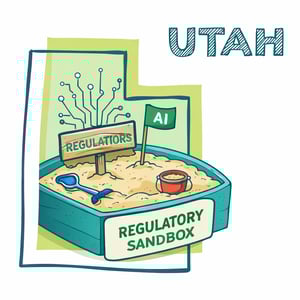
The Utah Department of Commerce, through its Office of Artificial Intelligence Policy, has announced a partnership with Doctronic to test autonomous AI for prescription renewals within the state’s regulatory sandbox framework.
According to the state’s announcement, this is the first state-approved program in the country allowing an AI system to legally participate in medical decision-making for routine medication refills.
The use case is specific but significant:
- Chronic condition medication renewals
- AI-driven refill authorization within defined guardrails
- Human oversight maintained
- Formal evaluation of safety, adherence, cost, and workflow impacts
Utah’s sandbox allows temporary regulatory mitigation to enable innovation in a controlled environment while data is gathered. The Office will evaluate clinical safety protocols, patient experience, and real-world effectiveness before broader expansion.
The stated goal is straightforward: to improve adherence, reduce delays, prevent avoidable hospital visits, and lower costs.
The implications are anything but simple.
Why This Could Be a Game Changer
Prescription renewals account for roughly 80% of medication activity. Medication noncompliance is tied to billions in avoidable spending and poor outcomes.
If autonomous AI can safely streamline routine renewals while keeping clinicians in the loop, the ripple effects could include:
- Reduced administrative burden on providers
- Improved refill timeliness
- Better medication adherence
- Downstream cost reductions for payers
Utah is positioning this as a “doctor, not device” model, emphasizing that automation supports, rather than replaces, human judgment.
But this effort is also a policy experiment.
If an adverse event occurs, it could slow similar initiatives nationwide. If successful, it could become the blueprint other states adopt.
The Sandbox Model: A Broader Trend?
Utah is not alone in exploring AI sandboxes. Arizona and Texas have established AI sandbox frameworks, and Wyoming is preparing its own. These initiatives reflect a growing state-level strategy: allowing innovation to proceed under structured oversight rather than waiting for sweeping federal regulation.
There are parallels to the federal shift toward public-private collaboration over prescriptive rulemaking. For example, CMS’s Health Ecosystem pledge model emphasizes coordinated commitments rather than immediate regulatory mandates.
Utah’s approach may represent the state-level version of that philosophy.
The policy question is whether collaborative governance can scale safely in high-stakes environments like healthcare.
The Broader AI Policy Landscape States Are Navigating
Utah’s move raises several questions that regulators, health systems, pharmacies, and payers should be actively tracking:
- Which states have passed laws limiting or authorizing specific healthcare AI use cases?
- Are states distinguishing between administrative AI (e.g., note-taking, billing, and other documentation) and clinical functions like supporting diagnosis, prescribing, or tracking efficacy?
- Are there guardrails specific to prescribing, renewals, diagnosis, or health plan determinations, such as prior authorization or claims processing?
- Are states requiring defined training data parameters, auditability, transparency disclosures, or bias testing?
- Are additional states exploring sandbox models for autonomous clinical AI?
The answers are evolving quickly.
Some states have enacted AI transparency laws. Others have proposed guardrails around algorithmic bias or prior authorization automation. Still others are signaling openness to innovation, provided safety monitoring is embedded.
This patchwork environment is precisely why policy monitoring must extend beyond bill tracking.
Monitoring Beyond the Statute
What makes Utah’s partnership notable is not only the AI use case. It is the regulatory mechanism that enables it.
Regulatory sandboxes, executive agency authority, pilot frameworks, and public reporting requirements are becoming central policy tools. These mechanisms often move faster than formal legislation and can influence national momentum.
Organizations that monitor only enacted laws may miss early indicators of where the market is heading.
That is why regulatory monitoring today must include:
- State AI policy proposals and enacted laws
- Executive office initiatives
- New sandbox establishment approvals
- Pilot programs
- Agency guidance and interpretive statements
- Cross-state trend analysis
Artificial intelligence in healthcare is no longer theoretical. It is operational, state-sanctioned, and measurable.
Looking Ahead
Utah’s partnership with Doctronic is a controlled experiment. Its outcomes will likely inform future state and potentially federal AI policy.
If it proves safe and effective, other states may replicate the model. If it encounters safety or governance challenges, regulators may tighten oversight.
Either way, this is a moment worth watching closely.
For organizations operating across multiple states, understanding how AI is permitted, restricted, or actively encouraged is a strategic necessity.
If you would like to learn more about how emerging AI policy trends intersect with healthcare regulation, reach out to me. I’d love to learn what AI policies you are most interested in keeping an eye on. We are already exploring a new AI-focused monitoring subscription service, so we have been closely monitoring this space. In this environment, the question is not whether AI policy will shape healthcare operations but how.