



Ambient listening isn't a future electronic health record (EHR) capability; it’s happening now.
In fact, nearly two-thirds (62.6%) of US hospitals that use Epic had adopted an ambient artificial intelligence (AI) documentation tool by the middle of last year.1 But despite this receptivity, many clinicians and organizations are still determining how to use it effectively.
As health systems and clinicians look for ways to overcome hurdles, life sciences companies and brand teams can support them in several ways, including the creation of templates that elevate consistency in use and governance.
Ambient Listening 101: What It Is and Why It Matters
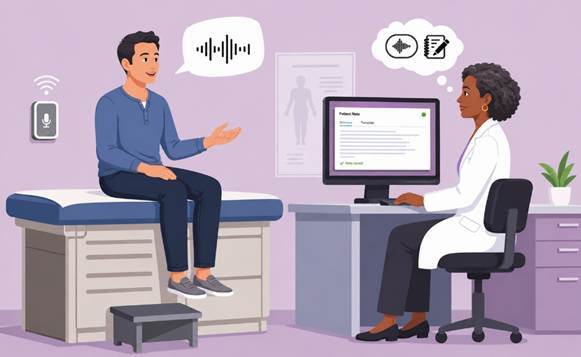
Ambient listening is a powerful AI voice recognition tool that passively listens to, interprets, and analyzes conversations between clinicians and patients. It converts these conversations into structured clinical notes, eliminating the need for manual capture. By lifting this administrative burden, physicians can not only save time but stay more focused on patients during visits.
While the clinical benefits of such a tool are easy to appreciate, adoption of ambient listening is currently outpacing its optimization. Why? Two reasons:
- The training gap. Whether it’s a lack of time or willingness, clinicians may not have awareness of best practices for clinical documentation with ambient AI
- There are real risks. Accuracy, liability, and patient trust are risks that emerge when implementation moves faster than education
For clinicians, ambient AI presents both a challenge and an opportunity. It can miss important context that isn't spoken aloud, but it can also allow providers to be more present and engaged during patient conversations. Embracing this tool is a giant first step, field teams supporting clinicians with resources around documentation best practices may be the difference between a tool that helps and one that truly transforms.
The Benefits of Ambient Listening Are Quantifiable
For a workforce that has long absorbed the time required for documentation as a personal cost, ambient AI is changing the equation. Across leading health systems, clinicians and systems using ambient AI have seen:
|
24% less time on notes, with some reclaiming nearly 2 hours of after-hours documentation per day2
|
26% reduction in note-related cognitive load in studies evaluating before and after ambient AI adoption3 |
44% reduction in clinician turnover after ambient AI integration, with improved retention reducing recruiting, onboarding, and training costs2 |


It’s a difference patients can feel in the room. When a clinician is buried in documentation, eye contact disappears, conversations get cut short, and the visit can become transactional, which can negatively impact patient satisfaction scores. With ambient listening, clinicians don’t need to be split between the screen and the conversation. In fact, a recent study documented a 20% improvement in clinicians' ability to give patients undivided attention after just 30 days of ambient AI adoption.3 And with the technology being used in more than 15 languages, ambient AI has proven compatible with diverse communities.2
Adoption Is Greatest In Specialties Who May Need It Most
The settings where ambient AI has taken deepest hold are also where the opportunity is most tangible for healthcare marketers. Adoption has concentrated in the departments carrying the heaviest documentation burden, and the data backs it up:
-
95% of ambient speech adopters among Epic users work in ambulatory care settings, with family medicine alone accounting for nearly 4 in 10 adopters4
- AI scribe use was highest in mental health (50%), emergency medicine (36%), and primary care (34%), with adoption tracking closely to where the workload was heaviest, not to age or years in practice5
And while adoption is accelerating, there are still clinicians and specialties on the sidelines who stand to benefit most from making the leap. For healthcare marketers, that means two distinct opportunities: supporting the specialties already using it to use it well and helping the specialties still on the sidelines understand why it matters.
Ambient Listening: Recognizing The Hurdles to Optimized Use
Despite the promise of ambient listening, it’s also easy to understand the friction points. After all, ambient AI is handling some of the most sensitive data in medicine: the conversation between a patient and their clinician. Protecting and accurately documenting that conversation is what separates a tool that works from one that truly delivers, and most organizations are still working through a few friction points to get there:
- Conversations don't automatically become data
- Ambient AI works best when clinicians follow a structured flow of questions tied to the visit type or disease state. Otherwise, free-flowing dialogue may not be captured in the discrete fields that power downstream workflows like After Visit Summaries, prior authorization, and order entry
- Accuracy and trust need to be elevated
- Concerns around misinterpretation and a sense of being monitored rather than supported are worth addressing head-on
- Privacy, compliance, and regulation are complex, but not insurmountable
- Updated security assessments, patient consent requirements, and evolving guidelines around liability add complexity, and the regulatory landscape is still shifting. Pharma companies that stay aware of these changes will be better positioned to support clinicians in a meaningful way
Helping health systems understand and address these friction points can be what separates a meaningful training partner from one that simply shows up with a brochure.
The Keys to Ambient AI That Resonates
Getting full value from ambient AI depends on two things working together:
|
Disease state-specific documentation templates, embedded prompts, and visit type checklists can help structure conversations in real time and ensure key topics are captured accurately for downstream needs such as prior authorization |
|
As clinicians spend less time focused on the screen, they may be less likely to see prompts at the point of care. Therefore, field teams must ensure that their time with clinicians provides enough value for the brand to be remembered and spoken about during visits |

.png?width=105&height=105&name=people%20in%20healthcare%20icon%20(2).png) Field teams understanding how this technology impacts the clinician/patient interaction and documentation
Field teams understanding how this technology impacts the clinician/patient interaction and documentation
For healthcare marketers, supporting the adoption and optimization of ambient AI means ensuring clinicians have what they need to use it to its full potential through targeted education
After all, the best thing ambient listening can do is help clinicians become better listeners.
Ready to Move from Adopted to Optimized? POCP Can Help
As ambient listening continues to advance and become embedded in everyday workflows, Point-of-Care Partners has the experience and expertise to help life sciences companies make the most of this shift, from developing documentation templates and EHR-based resources to preparing field teams for a changing exam room dynamic. POCP’s Regulatory Resource Center can also provide insight into state AI-policy requirements. For more information, including a free tailored assessment of your brand, contact me.
References:
- Yang F, Graetz I. Ambient AI tool adoption in US hospitals and associated factors. Am J Manag Care. 2026;32(1):e25-e30. doi:10.37765/ajmc.2026.89876
- Scott C. A smarter way to chart: how AI charting is reshaping the clinician and patient experience. EpicShare. May 19, 2025. Accessed June 16, 2026. https://www.epicshare.org/share-and-learn/john-muir-upmc-ai-charting
- Olson KD, Meeker D, Troup M, et al. Use of ambient AI scribes to reduce administrative burden and professional burnout. JAMA Netw Open. 2025;8(10):e2534976. doi:10.1001/jamanetworkopen.2025.34976
- KLAS Research. Ambient speech outcomes 2025: combating provider burnout & elevating the EHR experience. KLAS Arch Collaborative; 2025. Accessed June 15, 2026. Available from: https://klasresearch.com/archcollaborative/report/ambient-speech-outcomes-2025/652
- Tierney AA, Gayre G, Hoberman B, et al. Ambient artificial intelligence scribes: learnings after 1 year and over 2.5 million uses. NEJM Catal Innov Care Deliv. 2025;6(5):CAT.25.0040. doi:10.1056/CAT.25.0040